
Heat Tracing
The Hidden Cost Of Poor Heat Trace Documentation
Jul
The Hidden Cost of Poor Heat Trace Documentation
An educational guide for maintenance managers, plant engineers, reliability teams, and purchasing.
When a heat trace system fails, the problem is not always limited to a damaged cable, failed thermostat, or tripped circuit. In many facilities, the bigger challenge is figuring out what is installed, where it is powered from, and who changed it sometime during the previous decade.
Incomplete or outdated documentation can turn a routine repair into an industrial scavenger hunt. Maintenance personnel may have to trace circuits, identify panels, confirm which piping is protected, and determine whether field modifications were ever recorded. Purchasing may then struggle to identify the correct replacement cable, connection kit, controller, or accessory.
The result is longer troubleshooting time, higher labor costs, incorrect material orders, and a greater chance that a manageable maintenance issue becomes an emergency.
“We ordered exactly what was written down. Unfortunately, what was written down was from 2008.”
Why Heat Trace Documentation Matters
Heat trace documentation is more than a collection of drawings stored in a cabinet that no one has opened since the person who created them retired. It should be a working maintenance resource that helps answer several basic questions:
- What piping, equipment, or instrumentation is being protected?
- Which circuit supplies each heat-traced line?
- What type and wattage of heat trace cable is installed?
- What voltage and breaker size are being used?
- Where are the power connections, end seals, splices, and thermostats?
- What insulation type and thickness are installed?
- When was the circuit last tested?
- Has the circuit experienced repeated failures?
- Do the drawings and panel schedules still match the field installation?
That last question can occasionally produce nervous laughter.
When this information is current and accessible, maintenance, engineering, reliability, and purchasing teams can make better decisions before work begins.
1. Faster Troubleshooting and Repairs
Missing circuit lists, panel schedules, drawings, and line information force technicians to spend valuable time identifying the system before they can diagnose the problem.
Without good documentation, the troubleshooting process may begin with: “Does anyone know what breaker feeds this?” Followed shortly by: “Has anyone seen Carl? He used to know.”
Good documentation allows the maintenance team to quickly locate the correct circuit, understand what should be installed, review previous test results, and determine whether the problem is isolated or part of a larger pattern.
Technicians should be repairing the system—not conducting interviews with every employee who has worked at the plant since 1997.
2. Better Maintenance Planning
Accurate documentation makes it easier to plan heat trace inspections, testing, repairs, and system audits. Teams can organize work by operating area, control panel, circuit, process unit, or equipment type instead of reacting to individual failures as they occur.
This is especially important during summer and early fall. Most heat trace problems do not begin during cold weather—they are simply discovered then. Waiting until temperatures fall can leave a facility competing for limited materials, contractor availability, and outage windows.
Winter has an unfortunate habit of arriving at roughly the same time every year, yet it still manages to surprise some heat trace systems.
A current heat trace record helps the plant identify what needs attention while there is still time to plan the work properly.
3. Improved Reliability and Failure Analysis
Documentation should show more than what was originally installed. It should also record how each circuit performs over time.
- Insulation-resistance test results
- Operating-current readings
- Controller and thermostat settings
- Alarm history
- Repairs and component replacements
- Failed or damaged cable locations
- Changes made during piping or valve maintenance
- Recurring problems associated with a particular circuit
Year-over-year records can help reliability teams identify trends. If one circuit repeatedly fails, the issue may not be the cable alone. The circuit could be improperly designed, exposed to water intrusion, damaged during routine maintenance, incorrectly controlled, paired with deteriorated insulation, or located in the one area where everyone swears, “It was already like that.”
Replacing the same component three times without investigating the cause is not preventive maintenance. It is a subscription service.
4. More Accurate Purchasing Decisions
Heat trace components are not always interchangeable. Cable type, wattage, voltage, temperature rating, hazardous-area classification, chemical exposure, and compatibility with existing connection kits must all be considered.
Ordering a component based only on its appearance can be risky. “It looks about the same” is not generally considered a complete heat trace specification.
Accurate records give purchasing personnel the information they need to request the correct material and allow engineering or technical personnel to verify the selection before an order is placed.
- Manufacturer
- Product family and catalog number
- Wattage output
- Operating voltage
- Maximum exposure temperature
- Area classification
- Connection-kit type
- Controller or thermostat model
- Approved replacement or equivalent product
Purchasing would generally prefer to place one correct order rather than three increasingly urgent ones.
5. Safer Maintenance and Construction Activities
Heat trace cable is frequently hidden beneath insulation and metal jacketing. Employees or contractors replacing valves, repairing piping, installing supports, or removing insulation may not realize that a cable is present.
The cable, unfortunately, realizes that the contractor is present.
Clear drawings, line identification, warning labels, and maintenance records help communicate where heat trace is installed and what precautions are required before work begins.
This is particularly important before insulation work. Heat trace cable is durable, but it is not especially fond of sheet-metal screws, utility knives, or being treated as an inconvenient piece of string.
6. Preserving Plant Knowledge
Many facilities rely heavily on the experience of a small number of employees who know the system because they have worked with it for years. That experience is valuable, but it should not be the plant’s only source of information.
If your documentation strategy is “Ask Mike—he knows where everything is,” then Mike is your document-control system.
When drawings, panel schedules, circuit histories, test records, and repair notes are maintained, critical knowledge remains available when experienced employees retire, transfer, take vacation, or simply refuse to answer their phone during another freeze event.
Documentation turns individual knowledge into shared plant knowledge—and allows Mike to enjoy his vacation.
What Should Be Included in a Heat Trace Documentation Package?
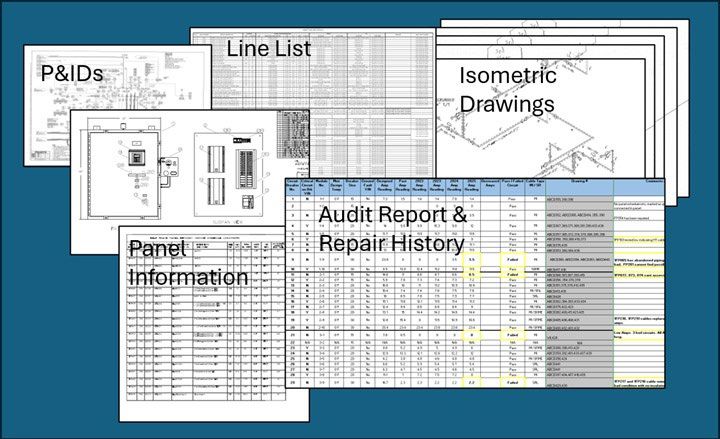
The level of documentation will depend on the size and complexity of the facility, but a practical package may include:
1. Heat Trace Line List
Identifies the piping, equipment, service, pipe size, maintain temperature, cable type, circuit, panel, and operating area. In other words, it answers: “What exactly is this circuit supposed to be heating?”
2. Panel and Circuit Schedules
Shows the relationship between breakers, contactors, controllers, alarms, and field circuits. Handwritten notes such as “possibly Area 4” are generally not ideal.
3. Marked-Up Drawings or Isometrics
Identifies cable routing, power connections, end seals, splices, tees, sensors, and other system components. Field changes should be incorporated into the documentation—not preserved exclusively in someone’s memory.
4. Cable and Component Information
Includes manufacturer, catalog number, voltage, wattage, temperature ratings, and approved replacement products. “Red cable” is not a catalog number.
5. Testing and Commissioning Records
Documents insulation-resistance testing, continuity, current readings, controller settings, and observed deficiencies. A test result of “seemed okay” may not be particularly helpful two winters from now.
6. Repair and Modification History
Records field changes, cable replacements, insulation repairs, piping modifications, and recurring failures. This helps prevent future technicians from trying the same unsuccessful repair with greater confidence.
7. Open-Item or Deficiency List
Prioritizes conditions requiring repair, further investigation, engineering review, or future capital planning. “Maybe next year” is not technically a plan.
A Practical Place to Start
A facility does not need to rebuild its entire documentation system at once. Begin with the areas that create the most risk or consume the most maintenance time:
- Circuits with repeated failures
- Critical process and instrument lines
- Areas with missing or damaged insulation
- Panels with outdated or illegible schedules
- Systems that have been modified repeatedly
- Circuits with unknown cable or component types
- Areas scheduled for upcoming maintenance or turnaround work
Another reasonable place to begin is the panel that everyone avoids opening because the schedule no longer resembles anything connected to it.
The objective is to create a reliable baseline and improve it as inspections, repairs, and testing are completed.
Turn Documentation Into a Working Maintenance Tool
Good heat trace documentation supports more than recordkeeping. It helps maintenance teams troubleshoot faster, plant engineers evaluate system changes, reliability teams identify recurring problems, and purchasing personnel order the correct materials.
Do your heat trace drawings and panel schedules still match what is installed in the field?
There is only one way to find out, and unfortunately, “probably” is not a documented answer.
Keep your processes and revenue flowing by reviewing your existing Heat Trace line lists, panel information, drawings, test records, and known problem areas to help identify documentation gaps and develop a practical plan for improving your heat trace records.
Because during a freeze event, your maintenance team should be fixing problems—not trying to solve a mystery.